



In the advanced journey of footwear care, most enthusiasts eventually move beyond the basic “stuffing paper” phase and into the world of quality wooden inserts. However, a new dilemma often arises at this stage: Should I buy a pair of adjustable shoe trees labeled “Small/Medium/Large,” or should I hunt down a fixed-size version that exactly matches my shoe size?
“The wrong size is more dangerous than no shoe tree at all,” says a technical manager responsible for size calibration at a prestigious shoemaker in Florence. Speaking on the condition of anonymity to protect brand secrets, he explains: “The essence of a shoe tree is to provide tension, but the ‘wrong tension’ is a destructive force. I have seen too many expensive Chelsea boots ruined because an oversized split-toe tree forced the heel leather to widen by 2mm, permanently compromising the fit.”
This guide delves into the mechanical differences between adjustable shoe trees and fixed sizes. The core problem we address is how to find the equilibrium between maintaining the shoe form and avoiding structural damage across various shoe lasts and leather types.
The Mechanics of Adjustable Shoe Trees
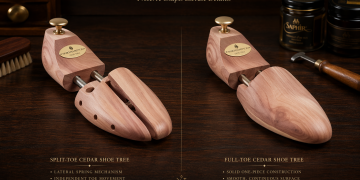
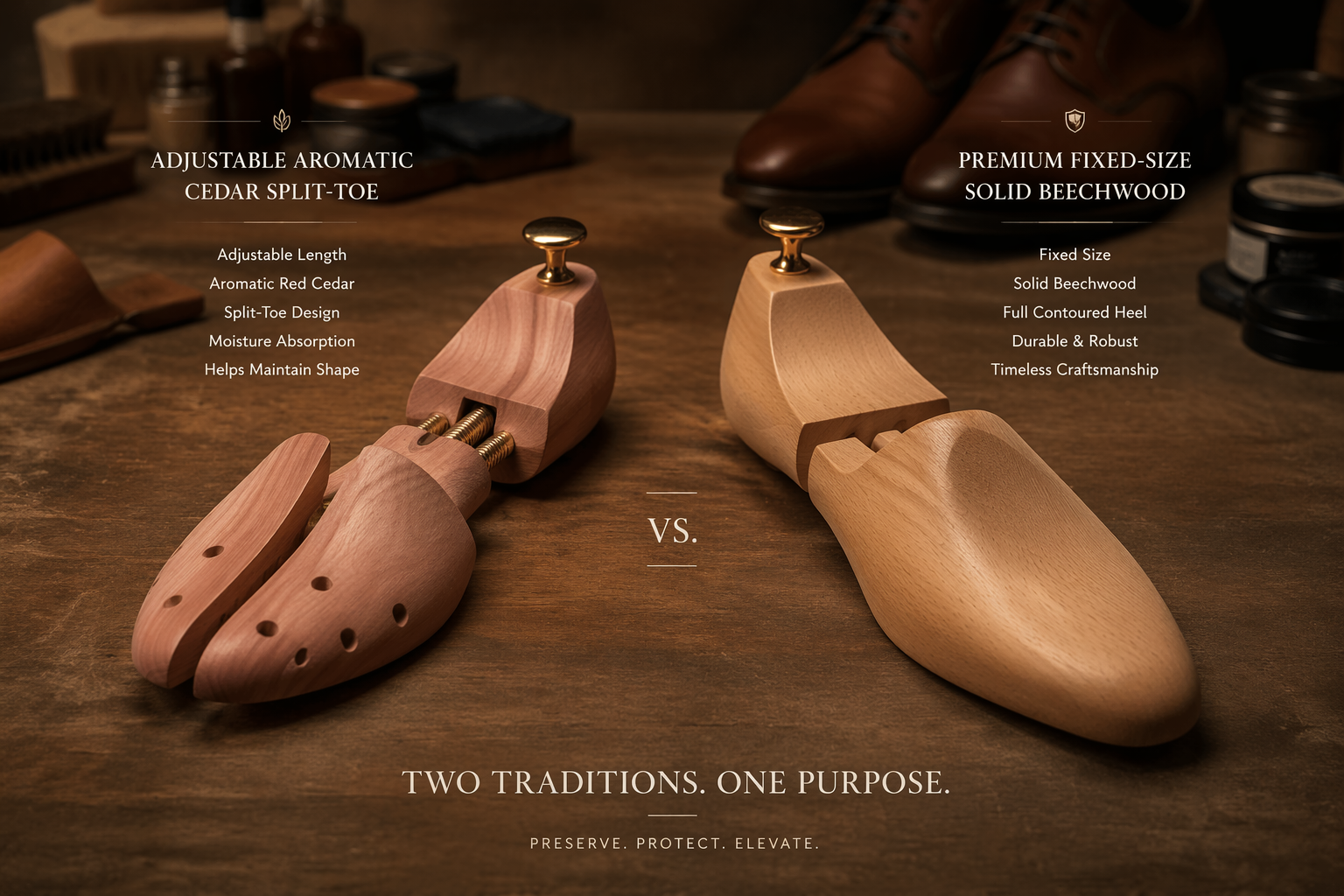
The most common adjustable shoe trees on the market utilize a spring-loaded system. These generally fall into two categories: “single-tube” and “split-toe.” Their primary design goal is versatility, aiming to cover a range of one to two full sizes.
Versatility Over Precision
The core advantage of adjustable designs is flexibility. For a collector owning various brands like Allen Edmonds, Alden, or Loake—each with slightly different sizing standards—a set of telescopic trees seems like a cost-effective solution.
- Single-tube Adjustment: Provides longitudinal pressure through a central metal spring.
- Split-toe Adjustment: In addition to length, the forefoot section expands laterally. This is a powerful tool for smoothing out the vamp area that has widened through wear.
The Blindness of the Spring
However, a spring lacks human perception. If you insert an adjustable shoe trees marked “Medium (US 8-9)” into a delicate US 8 calfskin loafer, the spring will be at high compression.
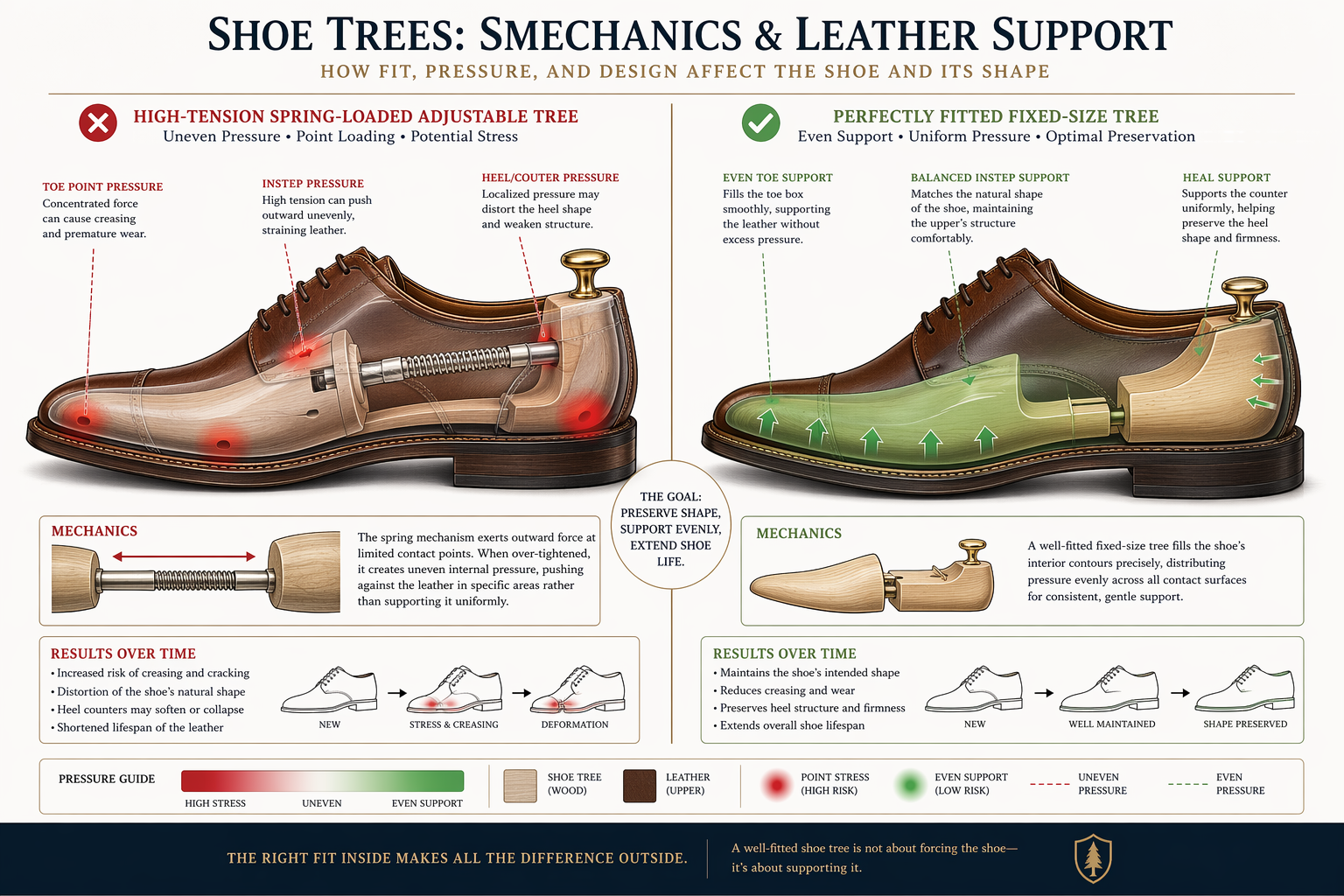
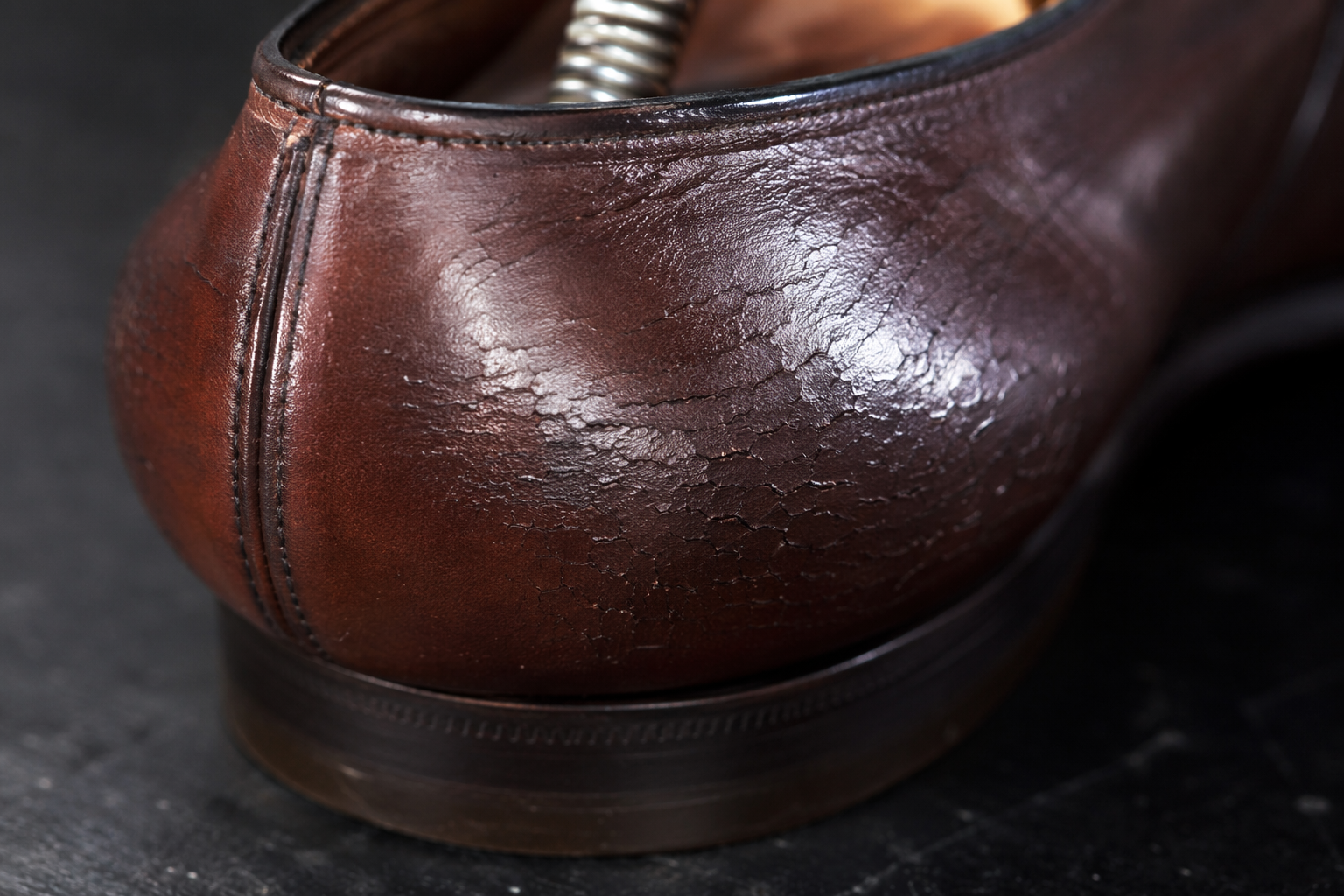
A veteran shoe collector shared his experience: “I used generic spring-loaded trees for my suede shoes, and after six months, the vamp had flattened significantly. The spring was pushing upward with constant force, over-stretching the leather until it lost its elegant arc.” This “over-tension” is an irreversible stretching of the leather fibers.
Fixed-Size Shoe Trees: Precision vs. Inflexibility
Fixed-size trees are strictly mapped to a single size (e.g., EU 41). In the world of bespoke footwear, these are often direct replicas of the original Last.
Preserving the Master Shoe Form
The value of a fixed-size tree lies in its precise, gentle volume displacement. It doesn’t rely on brute spring force but on anatomical fit.
- Static Stability: It ensures the footwear returns to its original design shape without subjected to unnecessary stress.
- Key Area Support: These are typically more voluminous in the arch and heel areas, preventing the heel leather from collapsing inward or widening outward.
The Trade-off: Zero Tolerance for Error
The price of precision is a lack of compatibility. As the expert technician noted: “If you are a half-size, finding a perfect fixed match can be difficult. You are forced to choose between rounding up or down. If the tree is even slightly too large, you may struggle to insert it without damaging the heel counter.”
Practical Guide: How to Define Your Shoe Form
To choose the right tree, you cannot rely solely on the number printed inside your shoe. A “Size 41” from two different brands can differ in length by as much as 10mm.
Measuring Internal Volume
Measure the internal space of the shoe rather than just your foot. Use a tape measure to determine the actual length from the tip of the toe to the curve of the heel.
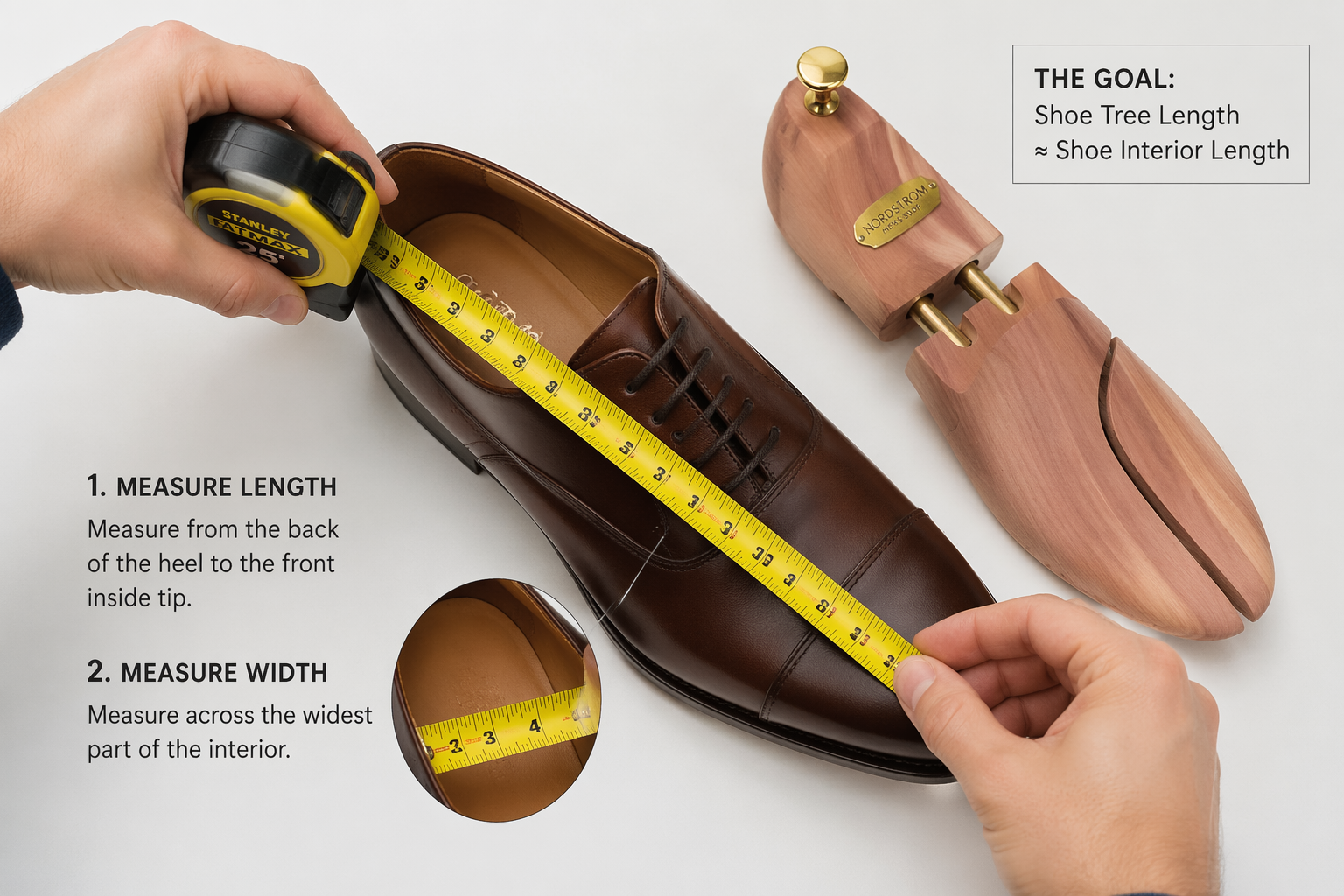
- The Matching Rule: Ideally, your shoe form should be 0.5cm to 1cm shorter than the internal length of the shoe. This allows for slight spring compression without creating an explosive outward force.
Considering the Last Shape
- Round vs. Pointy: Pointed shoes require a more elongated toe on the shoe tree. Forcing a wide American-style tree into a sharp Italian toe will cause unsightly bulges on the sides.
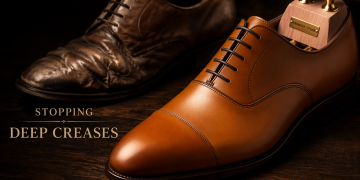
- Boots vs. Low-cuts: For boots, always seek dedicated boot trees. These provide higher ankle support, preventing the shaft from collapsing under its own weight and creating permanent deep creases.
Real-World Lessons: The Cost of a “Near Fit”
Leo, the Amateur Restorer
“I used to think a shoe form was just a placeholder. Then I started restoring shoes. I discovered that shoes stored with oversized, high-tension adjustable shoe trees often suffer from insole deformation. The footbed actually curves downward, causing uneven pressure on the wearer’s foot. Now I tell my clients: if your shoes cost more than $300, get a set of fixed-size cedar trees. Even a slightly smaller tree is better than one that is too large.”
Feedback from an Anonymous Enthusiast
“I once bought a bulk pack of generic plastic adjustable shoe trees on sale. They looked fine, but the springs were way too aggressive. They stretched my thin sheepskin loafers into a weird ‘wavy’ pattern. Now, those plastic trees are only for my sneakers. For my dress shoes, I only trust wood with specific sizing.”
Comparative Decision Matrix: Finding the Right Path
| Scenario | Recommended Type | Reason |
|---|---|---|
| High-end Dress Shoes | Fixed Size | Maintains exact lines; prevents stretching of fine leather. |
| Rugged Work Boots | Split-toe Adjustable | Thicker leather needs lateral pressure to smooth deep creases. |
| Ultra-thin Leather/Loafers | Fixed Size (Small half-size) | Prevents the ‘vamp bulge’ caused by springs. |
| Travel/Temporary Use | Single-tube Adjustable | Light and portable; safe for short-term use. |
| Sneakers/Casuals | Plastic Adjustable | Low cost; sufficient for maintaining basic synthetic shapes. |
Key Q&A: Addressing Sizing Anxiety
Q: If my shoes are size 41.5, should I buy a 41 or a 42 tree? A: Expert Tip: Buy the 41. It is always better for a tree to provide slightly less tension than to over-stretch the leather. A slightly smaller tree still provides moisture absorption and basic shape maintenance.
Q: Why can’t I use standard adjustable trees for boots? A: The center of gravity is different. A standard tree cannot support the weight of the boot shaft, which leads to heavy accumulation of creases at the ankle. Dedicated boot trees distribute this weight effectively.
Q: What if the spring feels loose? A: This is a signal. If a metal tube spring loses its tension, it is no longer providing effective structural support. For adjustable shoe trees, periodic inspection of spring elasticity is essential.
Conclusion: A Second Life for Your Footwear
Choosing a shoe tree should not be a gamble. Just as we shouldn’t wear ill-fitting shoes, we shouldn’t force our shoes into “ill-fitting” trees.
While adjustable shoe trees are convenient and economical, they function like a general-purpose medication. Fixed-size trees, on the other hand, are a precise prescription. Understanding your shoe form and respecting the unique curves of each shoe ensures that you are not just maintaining leather, but preserving a piece of your personal history.